Friday, February 21, 2014

If I had it to do all over again


On August 1, 2001, I became Dean and President of Nashotah House Theological Seminary.  I had spent the previous fifteen years as a faculty member at Trinity Episcopal School for Ministry, where I had directed the library, been an associate dean in three different capacities, and gone from assistant, to associate, to full professor in Systematic Theology.  Trinity had been formed in 1976 because a growing number of both Evangelical Episcopalians and those who had been involved in the Charismatic movement were convinced that none of the existing Episcopal seminaries could ever be reclaimed from the heterodoxy into which they had fallen or produce biblically faithful clergy who were capable of leading congregations in spiritual renewal.

From the beginning, people associated with Trinity realized that, if they were to be part of a spiritual renewal in the Episcopal Church, they would necessarily have to be somewhat counter-cultural to it.  One could not seek to be part of renewing the Episcopal Church while buying into the status quo.  Although I never heard it explicitly articulated, I think there was an implicit understanding on the part of some that, if the Episcopal Church could not be spiritually renewed and returned to biblical orthodoxy, an alternative would have to be found--or created.  This explains why so many Trinity alumni were among the early members of the Anglican Mission in America (AMiA), and John Rodgers, the Dean/President under whom I first served at Trinity (and one of the wisest and godliest men I have ever known), became one of the first two bishops consecrated for the AMiA.

During my years at Trinity, I happened to meet the professor who was then teaching Systematic Theology at Nashotah House (around 1994).  We were discussing which textbooks we used for teaching theology, and he remarked that he used John Macquarrie's Principles of Systematic Theology.  I gulped, and explained that, at Trinity, we treated Macquarrie in a separate course on Contemporary Theology where we did apologetics against him.  (I should add that this theology professor left Nashotah House before I began as Dean, and I had the opportunity to select his successor, who is thoroughly orthodox.)

Macquarrie was originally a Scottish Presbyterian who eventually became Lady Margaret Professor of Divinity at Oxford (from 1970 to 1986), but who, in 1965, had become an Episcopal priest in the United States while teaching at Union Theological Seminary.  Timothy Bradshaw, writing in the Handbook of Anglican Theologians, described Macquarrie as "unquestionably Anglicanism's most distinguished systematic theologian in the second half of the twentieth century."

After I moved to Nashotah House I discovered that the House had made Macquarrie an honorary Doctor of Canon Law in 1986.  But the fact is that Macquarrie's understanding of God is best understood as panentheism, "the belief that the Being of God includes and penetrates the whole universe."1  Macquarrie is a bridge between the existentialism of Martin Heidegger, the pantheism of Paul Tillich ("God is being-itself, not a being.") and Process Theology.  This existentialist and panentheistic foundation underlies the metaphorical theology of Sallie McFague, quoted approvingly on a number of occasions by Katharine Jefferts Schori.  I mention all this merely to make the point, once again, that ideas have consquences; and the current state of the Episcopal Church and other Western mainline traditions is the consequence of academically respectable theology that has gone from speculative, to heterodox, to pagan.

Both prior to joining the faculty at Trinity and throughout my tenure there, at various times I studied with and had good collegial ties with a number of faculty in other Episcopal seminaries, some of them legends from whom I learned a great deal But these professors, all of whom are now retired or deceased, were the exceptions, and the Episcopal Church isn't likely to see their kind again.  If I may be excused a bit of hyperbole, theological education in Episcopal seminaries for most of the past 50 years has been like the Curate's Egg--excellent in spots, but, on the whole, rotten.  To be more precise, Episcopal seminary education has concentrated on preparing men and women for a career in the Episcopal Church (note my choice of words) but has been utterly incapable of equipping them for biblically-faithful, Gospel-centered, Spirit-empowered ministry.  In short, I experienced first-hand, through my own studies and relationships, the precise reason why the founding of Trinity School for Ministry was necessary.

So, when I became Dean and President of Nashotah House, I had the same perspective.  It was not enough to prepare people for careers in the Episcopal Church.  It was vital to prepare them to be faithful to Holy Scripture and the Catholic faith and order of the Church, and to enable them to minister in the power of the Holy Spirit.  Though I make no pretense to Solomonic wisdom, upon becoming Dean and President at Nashotah House, I did pray Solomon's prayer:
Give your servant therefore an understanding mind to govern your people, that I may discern between good and evil, for who is able to govern this your great people?” (2 Kings 3:9)
To understand much of what happened during my time at Nashotah House, it is necessary to look at trends that have occurred in the Episcopal Church in recent decades and to understand some trends--what futurists such as John Naisbitt call "megatrends" that are having an inevitable impact on the Episcopal Church in the US and the larger Anglican Communion.   

There have been two competing (and irreconcilable) trends in the Episcopal Church for the past fifty years:  A growing spiritual renewal and a growing theological heterodoxy.

Most observers generally agree that the Charismatic movement in the Episcopal Church began with the Rev. Dennis Bennett's experience of the Holy Spirit while he was rector of St. Mark's Church in Van Nuys, California, in 1960.  The next thirty years saw a remarkable spiritual renewal that included leaders such as the Rev. Terry Fullam, from St. Paul's Church, Darien, Connecticut, and a list of other leaders and parishes that is much too long to list here.

Alongside that Charismatic renewal, Evangelicals in the Episcopal Church, which had long been a small and beleaguered minority, began to find new life and strength, and a sense of their own identity.  They were aided in their self-discovery by Evangelicals from the UK, Australia, and elsewhere.  There were organizations dedicated to promoting renewal in the Episcopal Church, but there were numerous, seemingly spontaneous examples of spiritual renewal popping up all over the Church as well.  Several entire dioceses began to take on the character of the renewal movement.  Those who had been touched by the Charismatic renewal and the Evangelical resurgence came to grips with the realization that no existing Episcopal seminary was capable of training biblically faithful, Spirit-filled clergy to serve and lead parishes.  This realization led to the founding of Trinity Episcopal School for Ministry.  

Increasingly, those affected by spiritual renewal and those being led in the direction of theological heterodoxy began to diverge.  In large part, this divergence occurred as theological liberals in the Episcopal Church became even more radical and began to act in ways contrary to the biblical and historic faith and order of the Church.  The Rt. Rev. Thad Barnum chronicles the liberal trajectory of the Episcopal Church and the orthodox response in his marvelous book, Never Silent.

During the 1990's and 2000's, I was a Deputy to the General Convention five times and observed this trajectory first hand--a growing rejection of biblical authority, a growing acceptance of departures from historic Christian norms in faith and morality, and a complete unwillingness to discipline those church leaders who departed from these norms.  In addition, I witnessed the growing marginalization and persecution of orthodox Christians in the Episcopal Church.  In the space of a few years, it seemed as though the Episcopal Church had become an environment that was toxic for an orthodox Christian.  The formation of the Anglican Mission in America (in 2000) and the Anglican Church in North America (in 2009) were the inevitable result.

In 2008-2009 two things happened that affected Nashotah House: (1) The Great Recession; and, more significantly, (2) the departure from the Episcopal Church of four of Nashotah House's most supportive dioceses: Fort Worth, Quincy, Pittsburgh, and San Joaquin.  They would later be joined by another diocese that sent a considerable number of students to the House: South Carolina.  

During my time as Dean and President, I tried to make Nashotah House a place where Anglicans of whatever stripe could prepare for ministries in the Church.  Students from TEC, AMiA, ACNA, continuing Anglican churches and other jurisdictions worshiped and studied side-by-side.  Jurisdictions didn't matter; students were there to become the best clergy and lay leaders they could be and to prepare to serve wherever God called them.  The House was a wholesome and peaceful place.  It was a time one faithful Bishop referred to as the "Pax Nashotah."  But it was not to last.

In 2010, in response to a growing number of Episcopalians in the Milwaukee area who were feeling alienated from their parishes, I led Nashotah House to begin holding Sunday morning worship services that were open to anyone (as were all of Nashotah House's daily services).  Several parishes in our area had been decimated in the years following the consecration of Gene Robinson as a bishop in TEC.  One local parish went from an Average Sunday Attendance of nearly 300 to only 100 in the space of a few years.  The parish my family and I attended had gone from nearly 150 ASA to 35 in the same period.  Another local parish went from 160 ASA to 60.  The Diocese of Milwaukee didn't seem to care where these departing Episcopalians were going; they were just upset that a portion of them started worshiping at Nashotah House.

The Sunday morning congregation, which took the name St. Michael's (after the historic bell tower on Nashotah's campus) did not start out to be an ACNA parish.  Despite rumors to the contrary, it was never my intention for it to be an ACNA parish.  As with students who came to Nashotah House, I was not concerned about jurisdictions, I was merely concerned to create places for faithful worship and teaching; and I thought that a congregation that was, to some degree, integrated into the life of a seminary could be  beneficial for both students and congregants.  In fact, members of the Sunday morning congregation did not become an ACNA parish until after I stepped down as Dean and left St. Michael's to work with another congregation in the Milwaukee area.  It was only then that St. Michael's formally organized as a parish separate from Nashotah House, called another priest to be their rector, and affiliated with the ACNA Diocese of Pittsburgh.  

The opposition to my remaining as Dean was driven ostensibly by Bishop Ed Salmon's contention that I was getting Nashotah House in trouble by being too closely allied with those who were outside of TEC.  The reason I use the word "ostensibly" is that it should have been apparent to all concerned (and should be doubly apparent in retrospect) that Bishop Salmon was using his position as Chairman of the Nashotah House Board of Trustees to undermine my position as Dean and President and to take the job for himself.  

Bishop Salmon could point to the fact that in the period 2009-2011 we saw a downturn in enrollment and contributions.  In answer to this, it should be obvious that four of our most supportive dioceses in terms of students and contributions had left the Episcopal Church, experienced a reduction or even a freeze on new postulants for holy orders, had their parish and diocesan funds frozen by the courts, and were having much of their current income consumed by litigation costs.  In addition, the US was experiencing the worst economic recession since the Great Depression. 

In my last year as Dean and the year following, a majority of the student body at Nashotah House came from ACNA dioceses.  The downturn we were experiencing was a temporary one as the ACNA found its legs and began to take off.  The House could have weathered this period and emerged as a seminary that, while continuing to train any students from TEC who wanted an orthodox seminary education, was free from TEC's unwholesome influence.  As proof of this one only has to look at Trinity School for Ministry, which took Episcopal out of its name and the Episcopal shield out of its logo.  In  recent years, Trinity has had no students from TEC in their incoming classes.  Yet, they have not only survived, they are thriving.

My experience at both Trinity and Nashotah House has led me to conclude:

1.  You can be an Anglican seminary outside the control of the Episcopal Church and still survive.
2.  You cannot be a seminary in the Episcopal Church and remain orthodox.

In witness to that, I point to the following news I received today: Bishop Iker Resigns in Protest From Nashotah House Board (because Bp. Salmon has invited Presiding Bishop Katharine Jefferts Schori to preach in Nashotah House's Chapel), an event that is shocking and tragic to many alumni.

Just as my "getting the House in Trouble" by reaching out to the AMiA and the ACNA and starting a congregation in the seminary chapel may have been the low point (as some would reckon it) of my deanship, the scandal of inviting Katharine Jefferts Schori to preach in the seminary chapel will probably go down as the low point of Bp. Salmon's deanship.  I can only say that I would put the low point of my deanship up against the low point of Bp. Salmon's deanship any day.  (I would also gladly compare the high points of my deanship with the high points of his.)


In Bp. Salmon's first interview as Dean and President, Doug LeBlanc reported
 

Salmon said he plans to strengthen relationships, both among seminary faculty and staff and between the seminary and bishops of the Episcopal Church. (Emphasis added.)
Well, now we see where that has led, don't we?  Salmon is further quoted as saying, 
"The name of leadership is relationships - people connecting with each other and working together," he said. "Our broken relationships in the Church are a testimony against the Gospel." 
No, Bishop, the heterodoxy of the Episcopal Church, in general, and of Katharine Jefferts Schori, in particular, is a testimony against the Gospel.  We are called to separate ourselves from false teachers; and a shepherd, whether of a diocese, a parish, or a seminary, is called to protect his flock from wolves.  In the words of the ordination vows Bishop Salmon took:  “Are you ready, with all faithful diligence, to banish and drive away all erroneous and strange doctrine contrary to God’s Word; and both privately and openly to call upon and encourage others to do the same?”  To lead a seminary like Nashotah House in these days, and to fail to keep that ordination vow, is to see your seminary turn into another Seabury-Western, or General, or worse.

In conclusion, let me point to three overarching conclusions:

1.  There is no movement today in the Episcopal Church capable of sustaining orthodox Christians or fostering the growth of orthodox congregations.

2.  In the absence of any movement designed to promote repentance, renewal, resurgence, and revival among orthodox Christians in the Episcopal Church, those Christians who remain in TEC are fighting a holding action and will ultimately lose through attrition.

Which leads to a third conclusion (which I say with great sadness):

3.  You can have orthodoxy or you can have the Episcopal Church, but you can't have both.

"Wait," some will say, "I am still in the Episcopal Church and I am orthodox, so I have both."  If that is true, then you are part of the remnant that is involved in fighting a holding action (whether you realize it or not).  So while your present situation may be safe for the moment, apart from divine intervention, the faith you hold, and the parish or diocese to which you belong (if they are still orthodox) will be lost in the next generation, if not in your lifetime.   

There are some, like Bishop Salmon, for whom relationships are more important than orthodoxy; and, in their cases, my words will fall on deaf ears.  History and the Righteous Judge before whom we both will stand will have the final say.  But, if I had it to do all over again, I would gladly, proudly, do the same.

-----------------

[Postscript:  I originally wrote the autobiographical part of the material in this post months ago but did not publish it because I was determined not to criticize my successor.  I wrote it mainly for my own journaling and reflection.  It is only this latest news of Bishop Salmon's decision to invite Katharine Jefferts Schori to preach at the House that has caused me to change my resolve.]

Saturday, February 15, 2014

"The Reconciliation Thing"

Recently, a longtime friend of mine, the Rev. Dr. Tory Baucum, Rector of Truro Church in Fairfax, Virginia, was named by the Archbishop of Canterbury as one of the Six Preachers of Canterbury Cathedral.  Tory is an outstanding preacher, pastor, and leader, and is worthy of this honor quite apart from any other accomplishments that might be mentioned.  However, this honor cannot be viewed apart from the fact that, as the press release from Lambeth Palace states, "his appointment is also recognition of his commitment to reconciliation, which is one of Archbishop Justin’s ministry priorities."

That set me thinking about the Archbishop's ministry priorities:  What is this reconciliation thing?  What does it mean?  And how should we view it?

At the time of Justin Welby's enthronement as Archbishop of Canterbury, he was quoted as saying:
“We are struggling with very, very significant divisions, different ways of looking at the world coming out of our context, coming out of our history....  Learning how we deal with those differences — which are of themselves valuable things — is really significant.
Welby went on to say,
“It is the key theological concept for Christian faith: reconciliation with God and the breaking down of barriers between people,” he said. “And therefore for me, I have this sense that part of the church’s role is to be reconciled reconcilers.”
Reporters at the time noted that Welby's role as Archbishop of Canterbury, "will be no easy task."
For the past decade, the Anglican Communion has been in turmoil after the Episcopal Church consecrated two openly gay bishops and moved to approve blessings for same-sex unions.  Several African and Asian jurisdictions accused the U.S. church of heresy.  Some conservative American congregations have broken away from the Episcopal Church and aligned themselves with Anglicans from other parts of the world.  There have been a series of contentious lawsuits over church property, and bitterness still prevails in many quarters throughout the Anglican Communion.
In response to the challenges ahead of him, Welby attempted to clarify his view of reconciliation:
“Reconciliation is extraordinarily painful for those involved in the conflict,” he admitted.  He said his view of reconciliation is not a “fuzzy wuzzy tolerance, sort of fluffy, where it would all be nice if we were nice to each other sort of rubbish.”
Frankly, it is on this last point that I am going to need convincing.  And the longer I see Dr. Welby in action, the more doubtful I become.

First of all there was the conference at Coventry Cathedral last year.  Anyone who has been around what I call (for lack of a better term) "professional religious dialogue" for very long knows how this sort of conference works:  Learned papers are shared; there is a lot of "deep" discussion; everyone shakes hands warmly and goes home feeling good--and nothing really changes.  With all due respect to those who met in Coventry, it seems that it was precisely one of those instances "where it would all be nice if we were nice to each other."  I am still waiting to see any real outcome from that conference that can affect the problems in the Anglican Communion. 

Today, I read the following headline:

Archbishop of Canterbury appeals for 'gracious reconciliation' in divided Church

The article was about Dr. Welby's presidential address to the Church of England General Synod, in which he said, 
"There is going to have to be a massive cultural change that accepts that people with whom I differ deeply are also deeply loved by Christ and therefore must be deeply loved by me, and love means seeking their flourishing."
He called on the Church to exhibit a love of the kind described in 1 John 4:18, which says "perfect love casts out fear".
"We all know that perfect love casts out fear. We know it although we don't often apply it," he said.
He pointed to the importance of the Church staying together in the midst of disagreement and how this could be an excellent witness to wider society.
"A Church that loves those with whom the majority deeply disagree is a church that will be unpleasantly challenging to a world where disagreement is either banned within a given group or removed and expelled," he said.
What was that again about reconciliation not being a “fuzzy wuzzy tolerance, sort of fluffy, where it would all be nice if we were nice to each other sort of rubbish”?

As I commented in a 2009 post on this blog, "Rowan Williams, Meet Neville Chamberlain," what the Anglican Communion needs is a Winston Churchill; but instead we keep getting Neville Chamberlains who proclaim peace in our time while the world goes to hell in a handbasket.

The problem in the Anglican Communion is not that we don't know how to live together despite our disagreements.  The problem is that Anglican (and other religious) leaders in the West have been so influenced by secular values that they have replaced the Gospel with those values and are incapable of asserting a faith that differs from what the secular culture around them can accept.  This is seen most clearly in matters of sexual morality, but that is only a presenting issue--a symptom of a deeper problem.

The problem in the Anglican Communion is that its leaders in the West have allowed so-called "modern biblical scholarship" and contemporary theologies (influenced by the skepticism and rationalism of our age) to undermine their confidence in the Bible and the message it proclaims.  They are no longer capable of believing that the eternal Son of God truly became incarnate through the Virgin Mary, died an atoning death for our sins, rose bodily from the grave with a body like that which all who believe in him shall someday receive, and ascended into heaven, from whence he shall come again at the end of this age to judge the living and the dead and to complete the redemption begun in his first coming.

Those who have listened to the message of the secular world instead of the authentic Gospel are incapable of believing the good news that is "the power of God for salvation to everyone who believes" (Romans 1:16).  They are incapable of believing that, "there is salvation in no one else, for there is no other name under heaven given among men by which we must be saved" (Acts 4:12).  And they are incapable of believing Jesus' words: "I am the way, and the truth, and the life.  No one comes to the Father except through me" (John 14:6).  

In short, they are lost, unbelieving souls, who should be the objects of evangelism, not partners in religious dialogue.  Which brings us to the biblical definition of reconciliation:

In Romans 5:6-11, we read:
For while we were still weak, at the right time Christ died for the ungodly.  For one will scarcely die for a righteous person—though perhaps for a good person one would dare even to die— but God shows his love for us in that while we were still sinners, Christ died for us.  Since, therefore, we have now been justified by his blood, much more shall we be saved by him from the wrath of God.  For if while we were enemies we were reconciled to God by the death of his Son, much more, now that we are reconciled, shall we be saved by his life.  More than that, we also rejoice in God through our Lord Jesus Christ, through whom we have now received reconciliation.
Do we believe that we were sinners, enemies of God and objects of his wrath?  If not, then we cannot be reconciled.  Do we believe that Christ's death was an atonement for the sins that separated us from God?  Unless we do, we cannot be reconciled.

In 2 Corinthians 5:17-21, we read:
Therefore, if anyone is in Christ, he is a new creation.  The old has passed away; behold, the new has come.   All this is from God, who through Christ reconciled us to himself and gave us the ministry of reconciliation; that is, in Christ God was reconciling the world to himself, not counting their trespasses against them, and entrusting to us the message of reconciliation.  Therefore, we are ambassadors for Christ, God making his appeal through us.  We implore you on behalf of Christ, be reconciled to God.  For our sake he made him to be sin who knew no sin, so that in him we might become the righteousness of God.
Our ministry of reconciliation only exists because, in Christ, we have been reconciled to God; and this reconciliation is grounded in the fact that the Incarnate Son of God, who knew no sin, became sin for us, so that in him we might become the righteousness of God.  Do we believe in Jesus' substitutionary atonement for us, paying the penalty for the sins that separated us from God?  If not, then we cannot be reconciled.  Have we, in gratitude, submitted ourselves to Christ?  Do we follow his commandments (John 14:21)?  If not, then we cannot be reconciled to God, which is the only basis for our being reconciled to each other.

1 Corinthians 1:10 says, "I appeal to you, brothers, by the name of our Lord Jesus Christ, that all of you agree, and that there be no divisions among you, but that you be united in the same mind and the same judgment."  Reconciliation is not living together despite our disagreements.  The basis for reconciliation is agreement in the truth. 

Jesus said, “Every kingdom divided against itself is laid waste, and no city or house divided against itself will stand."  Friends, this is the sad state of the Anglican Communion--a house divided against itself.  And unless there is agreement in the truth, talk of reconciliation is meaningless.

This is what the Anglican Communion must have if it is to survive:  Not a leader who tries to hold a plurality of viewpoints together, but a leader who leads us in the truth revealed in Jesus Christ and the Holy Scriptures and who calls us to follow.

Friday, February 07, 2014

Advice to Priests

On her blog, Held By His Pierced Hands, Meg Hunter-Kilmer has some important and convicting things to say in a piece entitled, "Advice to Priests:"
I was stunned the other day to have a good man, 25 years a priest, ask me for advice.  Not with a specific situation either, just “Do you have any advice for me?”  I didn’t know what to say to this priest of God, this man who speaks and the Word is made flesh, who grasps the hands of sinners to drag them back from the edge of that unscalable cliff, who leads people to Christ in a more real way than I ever will.

“Pray,” I said.  “Love Christ and his Church and pray.”

But he wanted more.  And I always have an opinion, even when I have no right to.  So add this to the list of things I have no business giving advice on.1

Image courtesy of Fr. Lawrence Lew, O.P.If I could ask one thing of priests, it would be this: celebrate the Sacraments like you believe that they’re real.  I imagine that most of you do believe that they’re real.  And I’ve been privileged to know many priests whose love of the Lord is so powerfully evident in the way they lead their people in prayer.  But that’s not always the case.  Imagine if you celebrated Mass completely attentive to the fact that you were about to call God down to earth.  Wouldn’t it be slower, more reverent, more intense?  Wouldn’t you be awestruck, holding the host in your hand?  Would you really make do with a quick bow if you honestly believed—or maybe remembered is the word—that Jesus Christ was truly there?  More than just doing the red and saying the black (which is a great start), what if you treated the sacred mysteries like they are sacred and mysterious?

Via.In a sacristy in Avila, the words surrounding the crucifix on the wall say, “Priest of Jesus Christ, celebrate this Holy Mass as if it were your first Mass, your last Mass, your only Mass.”  If you can’t excite the emotions your first Mass stirred up, can you try to imagine how you would say Mass if you knew you were about to meet God face to face?  You are, after all.
I don’t mean to imply that all you really need is emotions—or that if you try hard enough you can manufacture pious feelings.  I just mean that your people don’t need good homilies.*  They don’t need good administrators.  They don’t need friendly guys.  Those things are all nice, but what they need are pastors who are showing them what holiness looks like.  They need to see you and wonder at your love of the Lord.  They need to believe that it’s possible to know Christ, and you can teach them that by coming to know him better yourself.
[ Go to Meg's blog to read the rest. ]

* This is the only statement of Meg's with which I disagree.  Christians do need good sermons.  We are fed by both Word and Sacrament--in precisely that order.  Clergy need to preach every sermon as though we are calling God down to earth as well as lifting souls to heaven.  To follow Meg's analogy, we need to preach as if every sermon were our first sermon, our last sermon, our only sermon.

Tuesday, February 04, 2014

Well, DUH???

A choice quotation from the late John Hick, well known (liberal) philosopher of religion and author and editor of such books as The Metaphor of God Incarnate and The Myth of Christian Uniqueness:
If Jesus was literally God incarnate, the second Person of the holy Trinity, living a human life, so that the Christian religion was founded by God-on-earth in person, it is then very hard to escape from the traditional view that all mankind must be converted to the Christian faith.
(John Hick, God Has Many Names. Philadelphia: Westminster, 1982, p. 19.)

Wednesday, October 23, 2013

GAFCON 2: Calling the Leadership of the Anglican Communion to Faithfulness

It has been a busy couple of weeks, during which I have not had much time for blogging. But for those who are interested in developments in Anglicanism, especially as they relate to faithfulness to the Gospel, I want to call your attention to David Ould's posts from the Global Anglican Future Conference (GAFCON) currently going on in Nairobi, Kenya.

In particular, I want to call your attention to his post from Day 2. To set the stage, the tone for Day 1 of GAFCON was set by reflection on the Archbishop of Canterbury's meeting with the Primates just prior to the official beginning of GAFCON. On Day 3 of GAFCON, the attendees were shown an address by Archbishop Welby on video prepared especially for them and designed to convey greetings and support. It is a gross understatement to say that attendees were underwhelmed by Abp. Welby's remarks and dubious about Canterbury's ability to lead the Anglican Communion in an orthodox, faithful, and missional future.

But the address by GAFCON Chairman, Archbishop Eliud Wabukala on Day 2 was critical, in my opinion, in demonstrating what GAFCON means and where it is headed. As David Ould reports, this is the crucial paragraph from that address:
Five years on [since the first GAFCON conference], the paralysis of which we spoke has intensified. And it has become clear that the Communion now needs new wineskins, a new way of ordering its affairs to fulfill the world wide scope of the Great Commission. Even the Archbishop of Canterbury has now come to this conclusion and I am grateful for His Grace’s honesty in acknowledging that the Anglican Communion’s neo-colonial leadership structures need to be replaced when he preached here at All Saints Cathedral last Sunday. However, it is difficult to see how stable and effective leadership can be developed unless the depth of the spiritual crisis we face is acknowledged. Organisational change on its own will not be enough. Even the very weak theological discipline of the Anglican Covenant has failed to win consent despite years of negotiation and the Archbishop of Canterbury is no longer able to gather the Communion.
Or, as David Ould summarizes:
...it’s not enough for Welby to visit GAFCON and tell them that he recognises that the current structures are failing. If he will not deal with the real issues (the apostasy of the American and Canadian churches) then GAFCON will continue on without him. He no longer commands any leadership amongst them.
When I am able to do some original blogging, these are the questions I want to explore: What will happen to God and the Gospel as people pursue the various avenues that are open toward an Anglican future? And are the current structures of the Anglican Communion and its various provinces capable of demonstrating the kind of faithfulness that pleases God and carrying out the authentic mission of the Church that Jesus gave us (Matt. 28:18-20)?

These are the questions being asked by those attending GAFCON and by many Anglicans in both the Global North and South who have been affected by the tearing of the Anglican Communion's fabric in recent decades. As the final conference Communique emerges, I have no doubt that we will gain further clarity as to how these leaders, representing the vast majority of Anglicans worldwide, see the answers to these questions.

Friday, October 18, 2013

Wal-Mart worker: Fired for helping assaulted woman

I'll get back to Anglican and Gospel related matters shortly. But, in the meantime, here's a story that made my blood boil this morning:

From here:
Wal-Mart worker: Fired for helping assaulted woman

A Michigan man says he was fired from his job at Wal-Mart after he tried to help a woman being assaulted in the parking lot of one of the retail giant's stores and ended up fighting with her attacker.

Kristopher Oswald, 30, said he was in his car on his break about 2:30 a.m. Sunday when he saw a man grabbing a woman. He said he asked her if she needed help and the man started punching him in the head and yelling that he was going to kill him. Oswald said he was able to get on top of the man, but then two other men jumped him from behind.

A spokeswoman for Bentonville, Ark.-based Wal-Mart Stores Inc. told The Associated Press on Thursday that while the company understood Oswald's intentions, his actions violated company policy.

"We had to make a tough decision, one that we don't take lightly, and he's no longer with the company," company spokeswoman Ashley Hardie said.
If the story is true (and we'll know from the police reports whether it is true or not), this man should get a medal, not lose his job. As in so many cases, zero tolerance means zero intelligence. I thought Wal-Mart was a smarter company than this. But apparently not.

Tuesday, October 08, 2013

A Response to Christopher Seitz' "Why Encouragement for North American Parishes and Dioceses Matters?"

 The Rev. Professor Christopher Seitz has posted a piece on the Anglican Communion Institute website entitled, "Why Encouragement for North American Parishes and Dioceses Matters?"  In it he raises the possibility (or hope) that the established structures in those parts of the Anglican Communion that are following a new theological agenda might make some accommodation for traditional Anglicans.

The thing that mystifies me when I read Seitz' piece is that he seems not to take into account much of recent Anglican history.  The American Anglican Council, Forward in Faith, and others asked the same questions for twenty years about accommodation of traditional Anglicans that Seitz is asking now—to no avail.

The Anglican Communion Network of Dioceses and Parishes was formed in 2004 with ten dioceses and twelve bishops and asked repeatedly for some accommodation for traditional Anglicans, or even that the TEC leadership would take the concerns of traditionalists seriously.  No accommodation was forthcoming.  TEC continued its wayward direction and Canterbury did nothing to rein them in—in fact, Canterbury aided or acquiesced in the demotion of the Primates' meeting, the elevation of the Anglican Consultative Council, and the creation of a Joint Standing Committee to make sure the orthodox voices among the "instruments of unity" were marginalized. 

The Global Anglican Futures Conference (GAFCON), which first met in Jerusalem in 2009 and will meet again this month in Nairobi, is precisely the result of this history.  Orthodox Anglicans learned that they could not trust the existing Communion structures and set about creating their own.

Seitz' piece is well worth reading, if only to get that delightful sense of déjà vu.  When he asks, "Can Bishops be given oversight of parishes, if they exist in dioceses which wish to inhabit the new trails and new maps?"  I can't help but wonder where he was during the whole chapter on Delegated Episcopal Pastoral Oversight (DEPO).  We've been down that road.  A number of parishes expressed precisely that desire.  But in only a few cases, where there was a particularly charitable Episcopal bishop, was alternative oversight granted.  Read the Anglican Communion Institute's own proposal from 2004.  It went nowhere.

Seitz asks, "If a new liturgical rite, a new metro-political PB, and probably a new constitution (in the case of TEC, reinforcing a new polity) are now part of the agenda of the new season, will dioceses and parishes be permitted to do what has been done up until this new time, as the church inhabited this time and space previously?"  I think the recent history of the Diocese of South Carolina, as well as several other dioceses, has already given us an answer to that question.

When I read Seitz' statement, "Let justice and mercy kiss each other, as conservatives are permitted to remain on familiar trails, while the larger Episcopal and Anglican bodies in North America forge ahead where they believe God is calling them.  If in time they part ways, at least it could happen in a spirit of charity and loving-kindness," I feel as though I am reading something written in 1998, not 2013.

If in time they part ways???  Hello?  There is already a parting of the ways.  Several provinces in CAPA and the Global South have already declared themselves out of fellowship with TEC and have recognized the ACNA.  In 2008, more than 200 bishops boycotted the once-in-a-decade Lambeth Conference. When the Global South Primates met in Singapore, in April 2010, they invited Abp. Duncan to preside at the Eucharist.  When the Convocation of Anglican Provinces of Africa (CAPA) met in August 2010, the four primates at the head table were the current and outgoing heads of CAPA (Ian Ernest and Henry Luke Orombi), the Archbishop of Canterbury (Rowan Williams) and the Primate of the Anglican Church in North America (Robert Duncan).  How much stronger an indication could one look for that a parting of the ways has happened and that a realignment in Anglicanism is underway?  Now, the question going into GAFCON 2 is whether this parting of the ways is going to be a formal and permanent break

So my final question is, in light of all this, when is the Anglican Communion Institute going to stop dismissing the ACNA and GAFCON and recognize that a major and lasting realignment in Anglicanism (I would say the most significant development in Anglicanism since the Reformation) has already begun?

Saturday, September 21, 2013

Goodbye to Myers Briggs, the Fad That Won't Die

I wish all the colleagues I worked with at Trinity Episcopal School for Ministry in the 1980's and 90's could read this article.  Not that Trinity was unique--the Myers-Briggs Type Indicator is more sacred than Moses' two tablets in Episcopal circles.  But it seemed to be a particular obsession of some of my colleagues in those already mentioned decades.  Well it seems that yesterday's infallible personality test is today's Azande chicken divination.  From the Huffington Post, where there is more:
My name is Adam Grant, and I am an INTJ.  That's what I learned from a wildly popular personality test, which is taken by more than 2.5 million people a year, and used by 89 of the Fortune 100 companies.  It's called the Myers-Briggs Type Indicator (MBTI), and my score means that I'm more introverted than extraverted, intuiting than sensing, thinking than feeling, and judging than perceiving.  As I reflected on the results, I experienced flashes of insight.  Although I spend much of my time teaching and speaking on stage, I am more of an introvert -- I've always preferred a good book to a wild party.  And I have occasionally kept lists of my to-do lists.

But when I took the test a few months later, I was an ESFP.  Suddenly, I had become the life of the party, the guy who follows his heart and throws caution to the wind.  Had my personality changed, or is this test not all it's cracked up to be?  I began to read through the evidence, and I found that the MBTI is about as useful as a polygraph for detecting lies.  One researcher even called it an "act of irresponsible armchair philosophy."  When it comes to accuracy, if you put a horoscope on one end and a heart monitor on the other, the MBTI falls about halfway in between.
Read it all.

Saturday, August 17, 2013

Egypt: Islamists hit Christian churches

From the AP, where there is more:
After torching a Franciscan school, Islamists paraded three nuns on the streets like "prisoners of war" before a Muslim woman offered them refuge. Two other women working at the school were sexually harassed and abused as they fought their way through a mob.
In the four days since security forces cleared two sit-in camps by supporters of Egypt's ousted president, Islamists have attacked dozens of Coptic churches along with homes and businesses owned by the Christian minority. The campaign of intimidation appears to be a warning to Christians outside Cairo to stand down from political activism.

Christians have long suffered from discrimination and violence in Muslim majority Egypt, where they make up 10 percent of the population of 90 million. Attacks increased after the Islamists rose to power in the wake of the 2011 Arab Spring uprising that drove Hosni Mubarak from power, emboldening extremists. But Christians have come further under fire since President Mohammed Morsi was ousted on July 3, sparking a wave of Islamist anger led by Morsi's Muslim Brotherhood.
Read it all.

Wednesday, August 14, 2013

Urgent Prayers Needed for Egypt


A Message from Archbishop Mouneer Anis

14 August 2013

Dear Friends,

Greetings in the Name of our Lord Jesus Christ!
 

As I write these words, our St. Saviour’s Anglican Church in Suez is under heavy attack from those who support former President Mursi.  They are throwing stones and Molotov cocktails at the church and have destroyed the car of the Rev. Ehab Ayoub, the priest-in-charge of St. Saviour’s Church.  I am also aware that there are attacks on other Orthodox churches in Menyia and Suhag in Upper Egypt (see photo), as well as a Catholic church in Suez.  Some police stations are also under attack in different parts of Egypt.  Please pray and ask others to pray for this inflammable situation in Egypt.

Orthodox church under attack
Early this morning, the police supported by the army, encouraged protestors in two different locations in Cairo, to leave safely and go home.  It is worth mentioning that these protestors have been protesting for 6 weeks, blocking the roads.  The people in these neighborhoods have been suffering a great deal—not only these people, but those commuting through, especially those who are going to the airport.  The police created very safe passages for everyone to leave.  Many protestors left and went home, however, others resisted to leave and started to attack the police.  The police and army were very professional in responding to the attacks, and they used tear gas only when it was necessary.  The police then discovered caches of weapons and ammunition in these sites.  One area near Giza is now calm, but there is still some resistance at other sites.  There are even some snipers trying to attack the police and the army.  There are even some rumors that Muslim Brotherhood leaders asked the protestors in different cities to attack police stations, take weapons, and attack shops and churches.

A few hours later, violent demonstrations from Mursi supporters broke out in different cities and towns throughout Egypt.  The police and army are trying to maintain safety for all people and to disperse the protestors peacefully.  However, the supporters of former President Mursi have threatened that if they are dispersed from the current sites, they will move to other sites and continue to protest.   They also threatened to use violence.  There have been a number of fatalities and casualties from among the police as well as the protestors, but it seems that the numbers are not as high as expected for such violence.  However, the supporters of former President Mursi claim that there are very high numbers of casualties.  The real numbers will be known later on.

Please pray that the situation will calm down, for wisdom and tact for the police and the army, for the safety of all churches and congregations, and that all in Egypt would be safe.

May the Lord bless you!

+Mouneer

The Most Rev. Dr. Mouneer Hanna Anis

Bishop of the Episcopal / Anglican Diocese of Egypt

with North Africa and the Horn of Africa

President Bishop of the Episcopal / Anglican

Province of Jerusalem and the Middle East


http://dioceseofegypt.org/
 

Friday, August 09, 2013

Postmodernism: A Dangerous Mood

In his book, Recapture the Wonder, Christian apologist, Ravi Zacharias, summarizes the decline of Western society over the past 60 years:
In the 1950s kids lost their innocence.  They were liberated from their parents by well-paying jobs, cars, and lyrics in music that gave rise to a new term—the generation gap.

In the 1960s, kids lost their authority.  It was a decade of protest—church, state, and parents were all called into question and found wanting.  Their authority was rejected, yet nothing ever replaced it.

In the 1970s, kids lost their love.  It was the decade of me-ism dominated by hyphenated words beginning with self.  Self-image, Self-esteem, Self-assertion....  It made for a lonely world.  Kids learned everything there was to know about sex and forgot everything there was to know about love, and no one had the nerve to tell them there was a difference.

In the 1980s, kids lost their hope.  Stripped of innocence, authority and love and plagued by the horror of a nuclear nightmare, large and growing numbers of this generation stopped believing in the future.

In the 1990s kids lost their power to reason.  Less and less were they taught the very basics of language, truth, and logic and they grew up with the irrationality of a postmodern world.

In the new millennium, kids woke up and found out that somewhere in the midst of all this change, they had lost their imagination.  Violence and perversion entertained them till none could talk of killing innocents since none was innocent anymore.”
What caused these losses of innocence, authority, love, hope, reason, and imagination?  And how did our society get to this point? 

The late jurist Robert Bork, in his book Slouching toward Gomorrah, identified the two chief cultural influences of the past 60 years as being "radical individualism" and "radical egalitarianism."  In a nutshell, radical individualism means, "I can do whatever I want;" and radical egalitarianism means, "...and you don't have the authority to tell me otherwise."

These two influences have combined powerfully in the cultural movement of postmodernism, which is a mood—a dangerous mood—of skepticism in our interpretations of culture, literature, art, philosophy, and religion.  Zacharias comments, "A mood can be a dangerous state of mind, because it can crush reason under the weight of feeling.  But that is precisely what I believe postmodernism best represents - a mood.”

Most Christians are keenly aware of the way in which postmodern skepticism seems to be aimed particularly at Christians.  It is all right to express almost any religious idea as long as you do not bring Jesus Christ into it.  Zacharias notes: "If a spiritual idea is eastern, it is granted critical immunity; if western, it is thoroughly criticized. Thus, a journalist can walk into a church and mock its carryings on, but he or she dare not do the same if the ceremony is from eastern fold."  And the immunity from criticism being given to Islam, even by those who are quick to denounce Christianity as misogynist or homophobic, is glaring.

Truly the spirit of this age is the Christian apologist's greatest challenge.  We who know Jesus Christ to be "the way the truth and the life" are confronted with the fruit of a diabolically-sown seed.  To the assertion that "Jesus is the Way," we are told that there are many ways to God, many spiritual paths.  To the assertion that "Jesus is the Truth," we are told that there is no absolute truth that is valid for everyone.  To the assertion that "Jesus is the Life," we are offered many ways that our society calls "life," but the end of these paths is destruction.

A chief characteristic of those who are now looking at the world through postmodern eyes is that, for them, truth is no longer seen as the outcome of rational discourse but, rather, as a sympathetic identification with a point of view.  Something is true for them because they choose to believe it—they identify with it in a subjective or even emotional way.

So, while we might wish to see people come to Christ on the basis of a rational argument, my experience as one who has done apologetics for many years is that I never saw anyone persuaded to become a Christian on the basis of rational argument, and this was even prior to the rise of postmodernism. 

Rather, people must come to Christ because they are attracted to him.  "If I be lifted up..., I will draw all people to myself."  This means that we do not necessarily hold up Christianity as a superior philosophical system, even though we should commend the truth it teaches at every opportunity.  We do not necessarily hold up the Church as a more perfect society, although there should be something about the love among Christians that is compelling.  It means that we hold up the Savior and tell of what he has done for us and means to us.  And if we are authentic in our reflection of Jesus and his love, especially to those who are hurting in the midst of a lost world, he can use us to draw others to himself.

Ravi Zacharias, despite his own considerable experience in making persuasive arguments for Christianity, explains his own Christian perseverance this way:
“I came to Him because I did not know which way to turn.  I remained with Him because there is no other way I wish to turn.  I came to Him longing for something I did not have. I remain with Him because I have something I will not trade.  I came to Him as a stranger.  I remain with Him in the most intimate of friendships.  I came to Him unsure about the future.  I remain with Him certain about my destiny."  (Zacharias, Jesus Among Other Gods: The Absolute Claims of the Christian Message.)
This does not mean that our witness to Christ is devoid of rational appeal.  Christian philosopher J. P. Moreland cites the danger in an approach that is based solely on feelings or on presenting Jesus as the answer to human need:
"Today, we share the gospel as a means of addressing felt needs.  We give testimonies of changed lives and say to people if they want to become better parents or overcome depression or loneliness, that Jesus is their answer.  This approach to evangelism is inadequate for two reasons.  First, it does not reach people who may be out of touch with their feelings.  Second, it invites the response, “Sorry, I do not have a need.”  Have you noticed how no one responded to Paul in this manner?  In Acts 17-20, he based his preaching on the fact that the gospel is true and reasonable to believe.  He reasoned and tried to persuade people to intelligently accept Jesus."  (Moreland, Love Your God With All Your Mind: The Role of Reason in the Life of the Soul, p. 25.)
So our witness must be intelligent but, above all, winsome.  As theologian Alister McGrath puts it:
"Apologetics is to be seen not as a defensive and hostile reaction against the world, but as a welcome opportunity to exhibit, celebrate, and display the treasure chest of the Christian faith, and to explain and commend it to those outside the church.  It aims to set out the intellectual, moral, imaginative, and relational richness of the Christian faith—partly to reassure believers and help them develop their faith, but primarily to enable those outside the community of faith to realize the compelling vision that lies at the heart of the Christian gospel." (McGrath, Mere Apologetics: How to Help Seekers and Skeptics Find Faith.)
"...to enable those outside the community of faith to realize the compelling vision that lies at the heart of the Christian gospel."  That is our task.  How do we enable those to whom we witness to realize the compelling vision?  By first making it clear that the vision at the heart of the Gospel is compelling to us.  1 Peter 3:15 admonishes us: "but in your hearts honor Christ the Lord as holy; always be ready to make a defense to anyone who asks you for a reason for the hope that is in you; yet do it with gentleness and respect...."

Making it visible that we honor Christ the Lord in our hearts as holy is the first step in demonstrating to others that we find the Gospel to be compelling.  This does not mean making an exaggerated  display of our piety in front of others.  The world will only be reached by people who genuinely honor Christ in their hearts as holy (who display his enormous worth), not by those who make a show of being "holier-than-thou."

Why does Peter say, “Always be ready?”  Because Peter is looking back on his life and reflecting on a time when he denied he even knew Jesus three times in the space of one night.  But he also remembers the day of Pentecost when the Spirit of God came falling down on him and the other disciples, and they saw three thousand people come to the Lord in one morning.  It happened through the power of the Holy Spirit and because Peter had become a man who was ready to give an answer for the hope that was within him.

The dangerous mood of postmodernism is not giving people genuine answers.  People you know, people you meet, people who live next door to you, people who work with you are dying, both physically and spiritually.  It is only in the good news of Jesus Christ that people can find true life, hope, and peace.

Do you have the love of Jesus to share?  Are you empowered by the Holy Spirit?  And are you ready always to give an answer for the hope that is in you?

Tuesday, August 06, 2013

Tens of thousands rally to oust Tunisian government

It seems that the "Arab Spring" has become the winter of their discontent.  Pray for Tunisia and for the freedom of the Arab world.

From here:
Tens of thousands of Tunisians crowded the streets of downtown Tunis on Tuesday to demand the transitional government's ouster, in the largest opposition protest since the country's political crisis began two weeks ago.

 The secular opposition, angered by two assassinations in its ranks and emboldened by the army-backed toppling of Egypt's Islamist president, is trying to topple Tunisia's government led by the moderate Islamist party Ennahda.
It also wants to dissolve the Constituent Assembly, which is weeks away from finishing a draft constitution and election law.

In a surprise move that could tip the balance in the opposition's favor, the head of the Constituent Assembly suspended the body, saying it would not resume work until the government and its rivals held talks. Assemblyman and ruling party member Najib Mrad called the move an "unacceptable coup."

Tunisia is facing the worst political turmoil since autocratic ruler Zine el-Abidine Ben Ali was toppled. The crisis has been compounded by growing instability as Islamist militants step up their attacks.

"The people want the fall of the regime," shouted crowds crammed into Bardo Square, using the same slogan they popularized when Tunisians ousted Ben Ali in 2011 and sparked a wave of uprisings across the Arab world.

"This proves the desire for liberation from Brotherhood rule will not be broken," Belaid's widow, Basma Belaid, said, comparing Ennahda to Egypt's elected Muslim Brotherhood.
Read it all.

Friday, August 02, 2013

FIFNA, Anglicanism, and the Seventh Ecumenical Council [UPDATED]

David Virtue's website, VirtueOnline, recently reprinted a blog post by Joel Wilhelm, entitled "FiFNA vs. Anglicanism."  Readers of Anglican blogs may remember that, in June, the Stand Firm website ran an article: "What is Going on With the ACNA and the Filioque?" which cited another post by Wilhelm, entitled, "ACNA Vs. the 39 Articles," in which he challenges the ACNA for considering returning to the original form of the Nicene Creed, which does not contain the Filioque.  I don't know about you, but I am beginning to sense a theme with these "versus" articles:  Take an organization that is part of the Anglican Realignment and try to make the assertion that some adopted position of theirs is un-Anglican, or even un-biblical and un-Christian.  

What should we think of Mr. Wilhelm's latest assertion?  Here's the background:  Forward in Faith - North America (FIFNA) recently issued A Declaration of Common Faith and Purpose at their annual Assembly in Belleville, Illinois, which includes this statement for members to affirm:
I believe all Seven Councils are ecumenical and catholic on the basis of the received Tradition of the ancient Undivided Church of East and West.
Wilhelm then calls our attention to the Seventh Ecumenical Council, one of whose canons states:
Let relics of the Holy Martyrs be placed in such churches as have been consecrated without them, and this with the accustomed prayers. But whoever shall consecrate a church without these shall be deposed as a transgressor of the traditions of the Church.
Of course, the  Seventh Ecumenical Council, also known as the Second Council of Nicaea (because it was held in that city), affirmed a great many things, including the character of Christ's human nature, the Christian view of matter, and a fuller understanding of Christian salvation and the redemption of the material universe.  The Council also condemned the selling of ecclesiastical offices for money (simony) and declared ecclesiastical appointments by political rulers to be void.  But the Council is chiefly known for affirming the use of icons and relics--chiefly known because of the controversy that attended these matters--a controversy that continues to divide low-church and high-church Anglicans.

It is the controversy concerning relics to which Wilhelm seeks to call our attention.  Having quoted one of the canons from the Seventh Council (above), he goes on to assert:
This canon assumes that *every* church must contain 'relics' and that if it is not consecrated with relics, then whoever consecrated the church is a transgressor of tradition.  How is this in any way Scriptural?  It is an unnecessary binding of the conscience and makes most Anglican churches in the world illegitimate.  Has your parish been consecrated without relics?  If so, your priest should be deposed as a transgressor of the traditions of the Church according to FIFNA’s logic.
Next, Wilhelm quotes the Council's anathemas against those who condemn icons or misstate the Church's position regarding their use:
We salute the venerable images.  We place under anathema those who do not do this.  Anathema to them who presume to apply to the venerable images the things said in Holy Scripture about idols.  Anathema to those who do not salute the holy and venerable images.  Anathema to those who call the sacred images idols.  Anathema to those who say that Christians resort to the sacred images as to gods.  Anathema to those who say that any other delivered us from idols except Christ our God.  Anathema to those who dare to say that at any time the Catholic Church received idols.
Finally, Wilhelm asks, How does this match up with our Articles of Religion?  For example:
General Councils may not be gathered together without the commandment and will of Princes.  And when they be gathered together, (forasmuch as they be an assembly of men, whereof all be not governed with the Spirit and Word of God,) they may err, and sometimes have erred, even in things pertaining unto God.  Wherefore things ordained by them as necessary to salvation have neither strength nor authority, unless it may be declared that they be taken out of holy Scripture.  [Article XXI]
Or
The Romish Doctrine concerning Purgatory, Pardons, Worshipping and Adoration, as well of Images as of Relics, and also Invocation of Saints, is a fond thing, vainly invented, and grounded upon no warranty of Scripture, but rather repugnant to the Word of God. [Article XXII]

And he concludes by saying:
The Seventh Council and the Anglican Reformation cannot coexist.  FIFNA chooses the Seventh Council, so be it, then have the honesty to take the Articles on head on, rather than working your way into leadership positions and subverting Reformed Anglicanism from within.
What are we to make of Joel Wilhelm's assertions?  Can the Seventh Council and the Anglican Reformation (as represented by the Articles of Religion) coexist in our understanding?  And is FIFNA's position an attempt to subvert Reformed Anglicanism from within?

First a little background:  In the centuries prior to the Reformation, there was a use of images (mostly statues in the West, not icons) along with saints' relics that, especially among poor and illiterate people, was the cause of superstition to the extent that it could be said to be idolatrous.  Statues and relics that were intended to remind the faithful of their connection to great Christians of ages past were instead treated as though they were magic. The response of some in the Reformation was to destroy these images. 

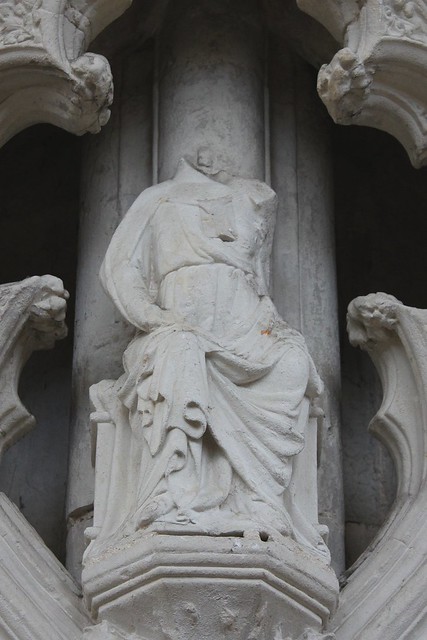
As in this photo, numerous statues in churches were smashed or beheaded.  Imagine a hundred little alcoves like this one, with the statues within all beheaded, and you will have what the walls of the side chapel in Ely Cathedral look like following vandalism by those who considered themselves to be acting on the principles of the Reformation.  This happened all over England.

The superstition that had arisen regarding images and relics is what Article XXII is referring to when it speaks of "the Romish Docrine...."  To be fair, the term "Doctrine" could be applied more accurately to Purgatory, Pardons, and the Invocation of Saints, but the Article lumps all these items into one category. 

But, "the Romish Doctrine" or idolatrous misuse of images and relics is not what the Seventh Council is endorsing in its canon.  In fact, the Seventh Council is saying that images or icons should not be viewed or treated as idols.  This canon applies as much to those who would be tempted to regard images and relics as idols as it does to those who would regard their proper use as idolatrous.

Consider the words of St. John of Damascus: 
Concerning the charge of idolatry: Icons are not idols but symbols, therefore when an Orthodox venerates an icon, he is not guilty of idolatry.  He is not worshiping the symbol, but merely venerating it.  Such veneration is not directed toward wood, or paint or stone, but towards the person depicted.  Therefore relative honor is shown to material objects, but worship is due to God alone.
 
We do not make obeisance to the nature of wood, but we revere and do obeisance to Him who was crucified on the Cross...  When the two beams of the Cross are joined together I adore the figure because of Christ who was crucified on the Cross, but if the beams are separated, I throw them away and burn them.
How should we regard the Council's injunction about relics?  The answer lies in the very Articles of Religion that Wilhelm cites:
[Councils] may err, and sometimes have erred, even in things pertaining unto God.  Wherefore things ordained by them as necessary to salvation have neither strength nor authority, unless it may be declared that they be taken out of holy Scripture.
In addition to the many other matters covered by the Seventh Council, it commends the use of icons and relics, which should not present a problem, as long as they are not being made into idols--which the Seventh Council regards as being just as wrong as the Articles of Religion do.   But when the Council goes on to say: "But whoever shall consecrate a church without these shall be deposed as a transgressor of the traditions of the Church," it is going beyond Holy Scripture, and we need to regard (or disregard) it accordingly.  

This is a different matter than saying we reject the Seventh Council.  Rather we affirm the Seventh Council, but we read its conclusions in light of Holy Scripture and other theological developments that refine our understanding--such as the Articles of Religion.  This is the constructive way to do theology.  It is synthetical rather than polemical.  We read Scripture in light of other Scripture--and in light of the consensus of the faithful as to its meaning.  We read theology, not taking one Church Father, Council, theologian, or theological movement in isolation, but in light of Holy Scripture and the same catholic consensus down through the ages.

The Seventh Council also forbade clergy from serving more than one parish simultaneously; it forbade women from serving as housekeepers in a bishop's residence or monastery; and it forbade the establishment of "double monasteries"--monasteries of both men and women.  Do we follow these injunctions today?  And if we do not, does it mean that we are rejecting the Seventh Council?  The fact is that a number of the Seven Councils issued canons containing details that we do not follow today, but instead, temper in light of the other sources that contribute to our theological understanding.  It does not mean that we are rejecting the Councils.

As a further example, many of those who object to the Seventh Council are Calvinists.  Does that mean they adhere to Calvin's Regulative Principle of Worship?  Do they use only Psalms, sung with no musical instruments, in their worship?  After all, Calvin closely associated his opposition to icons with his opposition to musical instruments.  And one of the things the Reformers (and the Puritans a century later) did after smashing images in churches was to board up or destroy the pipe organs.  My guess is that these modern-day Calvinists do not sing Psalms exclusively in their worship or forbid the use of musical instruments.  Yet they still consider themselves Calvinists.  How is that?  It is very simple:  they adhere to Calvin, but they temper his words and apply them in the light of other theological influences.  That is precisely how we read the Councils in the light of the Articles of Religion and other Anglican formularies, and, above all, Holy Scripture.

So can the Seventh Council and the Articles of Religion coexist?  Yes, as we read and apply them both in the light of Scripture.  Is FIFNA's position an attempt to subvert Reformed Anglicanism from within?  Frankly, that is a dangerous and divisive assertion, and one that should not be recklessly thrown at our brothers and sisters who are coming together in the Anglican Realignment.  Are there continuing differences between Anglo-Catholic and Evangelical Anglicans?  Yes, and we will only resolve them for the glory of God if we stop listening to those who, it seems, only wish to sow division instead of working for genuine theological understanding and the unity of the Church for which our Lord prayed (John 17).

UPDATE:  Three additional point I would like to mention.

1.  It should be noted that the FIFNA declaration does not call for subscription to every canon and anathema from all Seven Councils, it merely calls on its members to acknowledge that "all Seven Councils are ecumenical and catholic on the basis of the received Tradition of the ancient Undivided Church of East and West."  This is simply an accurate historical statement.  The churches of the East and West have always acknowledged all Seven Councils to be "ecumenical and catholic," that is, to have been participated in and accepted by representatives of the universal church as it existed at that time.  With regard to the Seventh Council, it was convened under the authority of the Patriarch of Constantinople, two Roman legates representing the Pope, and representatives of the Patriarchs of Alexandria, Antioch, and Jerusalem.  Whatever else may be said about the Seventh Council, it was definitely ecumenical and catholic.

2.  Regarding the canonical status and authority of the Seven Councils, consider this statement as to how the Councils are viewed by the Eastern Orthodox:
The canons of the Ecumenical Councils are regarded within the Orthodox Church as universally authoritative, though not in a strictly constructionist sense.  Their canons have often been repealed or revised by the decisions of local synods or even of later Ecumenical Councils.   Nevertheless, their legislation is central to the Orthodox canonical tradition, and appeals to such canons are more frequently made than to any other source of canonical legislation.
 This statement as to how the canons of the Councils may be repealed, or modified in light of subsequent theological understandings comes very close to how I believe the Councils are viewed by FIFNA and other traditionalist Anglicans.

3.  Regarding FIFNA's new Declaration of Common Faith and Purpose, in general, I highly recommend the article, "A Hasty, but Comprehensive Response to Critics of the New FiFNA Declaration" by the Rev. Nathaniel Kidd on the Sed Contra blog.

Thursday, August 01, 2013

The Canterbury Sidestep

It must be terribly embarrassing for the Archbishop of Canterbury to open the International Business Times and read a headline like this:

Archbishop of Canterbury: Church Investment in Porn is Life in the Real World 

But that is what happens when you try to defend the indefensible, which is what the Archbishop did when confronted by a radio interviewer about the fact that the Church of England has invested portions of its $8 billion in endowments in companies that produce pornography and engage in other unwholesome (not to say un-Christian) business practices.  The National Catholic Register described the episode this way:
It came out that the Anglican Church has been investing its money in companies that profit pornography and gambling--  Yes, porn and gambling.  Further, the investment rules of the Church specifically allowed for such investments stating "The Church's fund can invest in a company which holds up to 25% investment in industries such as pornography, gambling and pay-day lending, as well as 10% in weapons."  Well then, its only 25% sinful I suppose.
Ok, so the investments were handled poorly.  To say the least.  But the real death-knell of Anglicanism came from the Archbishop's initial response to something absolutely repugnant to the Christianity they purport to preach.  The Archbishop's response: "We've got to live in the real world and that means life is very complicated and you cannot sidestep the complexity. We've also got to be involved in day-to-day life and ask 'how do you actually live in the reality of the complexity of life today?'"
Try having this conversation with someone who is involved in a sexual relationship outside marriage or in other ways not living according to standards of Christian morality, and you'll probably get the same response:  "You're not living in the real world.  In the real world, everybody's doing it.  Life is more complex than your simple morality.  This is what the real world is like, and you'd better just get used to it."  Only now, we're hearing this same argument being used by the titular leader of a major branch of Christianity.

It seems that,in this and so many ways, such as his support for civil partnerships in the UK, this Archbishop is more interested in following "the real world" than the real Gospel.

[Sigh.]  And to think some conservatives were so hopeful over his election....